
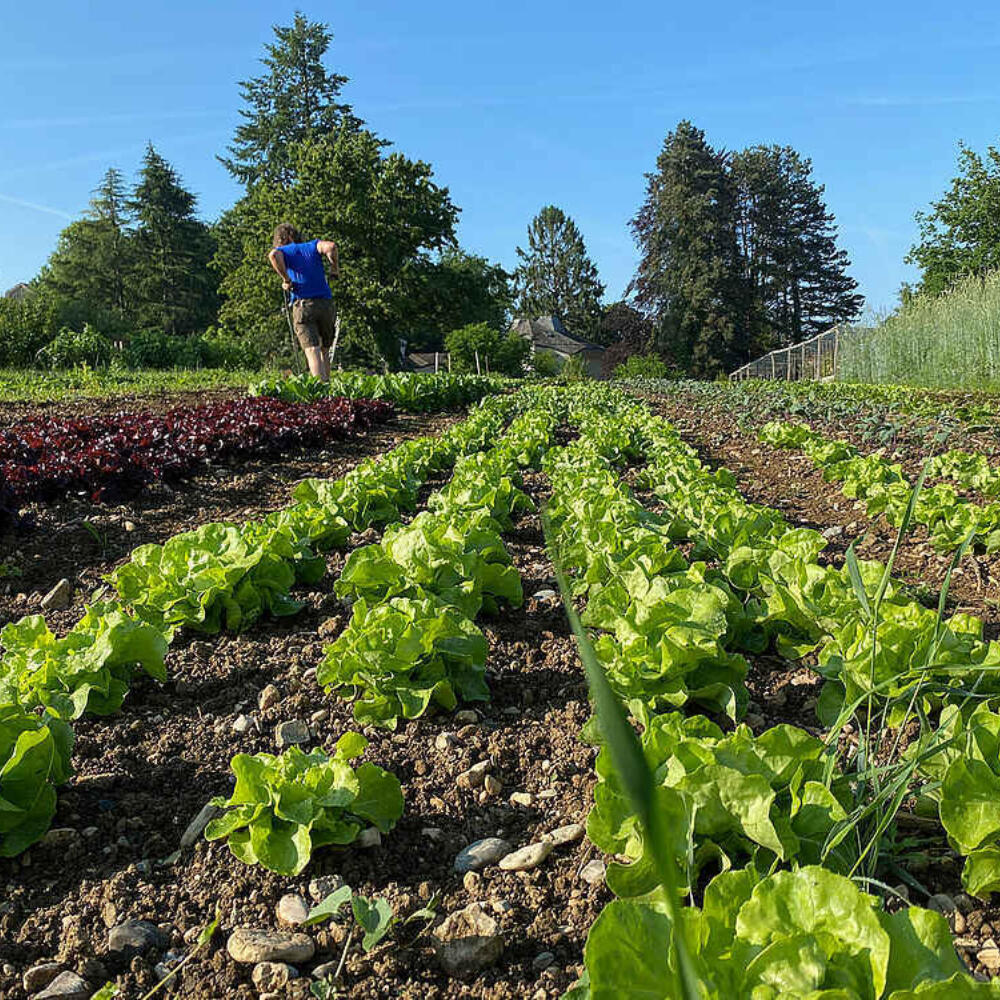
Hippocrates, the ancient Greek physician, already postulated that food should be the remedy. To some extent, this is still true today, because if food grows in living soil, it is healthy and can promote human health. In this respect, it is a remedy. At the same time, living soil is important for a healthy ecosystem and for mitigating the climate crisis, and is therefore also a remedy.
‘The world must make the soil good’ is the heading in Spektrum der Wissenschaft for a contribution by science journalist Roland Knauer (2025). He explains that conventional intensive agriculture has significant harmful consequences because it reduces the quality of soils and thus their fertility. Around 40 per cent of agricultural land worldwide was affected. In the long term, this would jeopardise food production. According to the UN FAO (Food and Agriculture Organization), one-fifth of humanity is already affected. The number of hungry people is steadily increasing, and the second goal of the United Nations' programme for sustainable development, “Zero Hunger” by 2030, is moving further and further away (SDG2, https://sdgs.un.org/goals). But to this day, conventional intensive agriculture is being exported to low-income countries, with the result that the diverse, small-scale agriculture that usually prevails in such countries is being displaced.
Dependencies are created and food sovereignty is eroded. The introduced monocultures are treated with synthetic fertilisers and pesticides, which leave residues. This reduces soil life and promotes the leaching of nutrients. If the focus is on yield and too little attention is paid to binding organic carbon in the soil, the soil gradually becomes poorer and produces lower yields. It is literally a case of desertification. Heavy rainfall, but also a lack of plant growth, increase erosion. In dry summers, areas with light soils sometimes experience huge dust clouds. The upper soil layer is blown away by the wind. Because humus is missing, the water holding capacity and thus climate resilience are reduced.
Making the soil good means revitalising it, building up organic matter and promoting the formation of humus. ‘Cover the soil’ is the magic formula here. Plant growth stimulates soil life and, through rooting, brings light, air and water into the soil. Another effect is that the organic matter binds carbon dioxide, a greenhouse gas. However, if soil depletion is counteracted with ever more fertilisers and pesticides, and food crops are grown conventionally, neither a healthy field nor a healthy meal is possible. Biodynamic agriculture is part of the solution to the climate and food crises. Farmers focus on soil care, and vital, tasty food ends up on our plates.
Sources:
Knauer R (2025), Die Welt muss Boden gut machen, Spektrum der Wissenschaft, Issue 4.25, 50–55.
Wassermann B, Müller H, Berg G (2019), An apple a day: Which bacteria do we eat with organic and conventional apples? Front Microbiol. 2019 Jul 24;10:1629. doi: 10.3389/fmicb.2019.01629
