Exploring new avenues: transdisciplinarity in agricultural research

Exploring new avenues: transdisciplinarity in agricultural research

14 August 2024

Exploring new avenues: transdisciplinarity in agricultural research

Created by Lukas Maschek | |   Research-Results

In a discussion article, Cyrille Rigolot, a member of the INRAE (National Research Institute for Agriculture, Food and Environment, France), analyses possible synergies between biodynamic agriculture and transdisciplinary research. Rigolot argues that, in contrast to other approaches, biodynamic agriculture also incorporates non-material dimensions of life. The resulting specific agricultural practices are characterised by a close relationship between humans and nature.

Biodynamic agriculture is based on the ‘Goethean approach to research’, which emphasises the importance of human perception and imagination in scientific practice. Rather than relying solely on empirical data and objectivity, the Goethean approach invites us to understand nature as a dynamic process that cannot be fully captured by analytical methods.

Even if some of the foundations of biodynamics are not yet sufficiently supported scientifically, it has nevertheless made significant agricultural innovations, such as mother-bound calf raising and the use of preparations. Biodynamic agriculture also inspired several principles of organic farming.
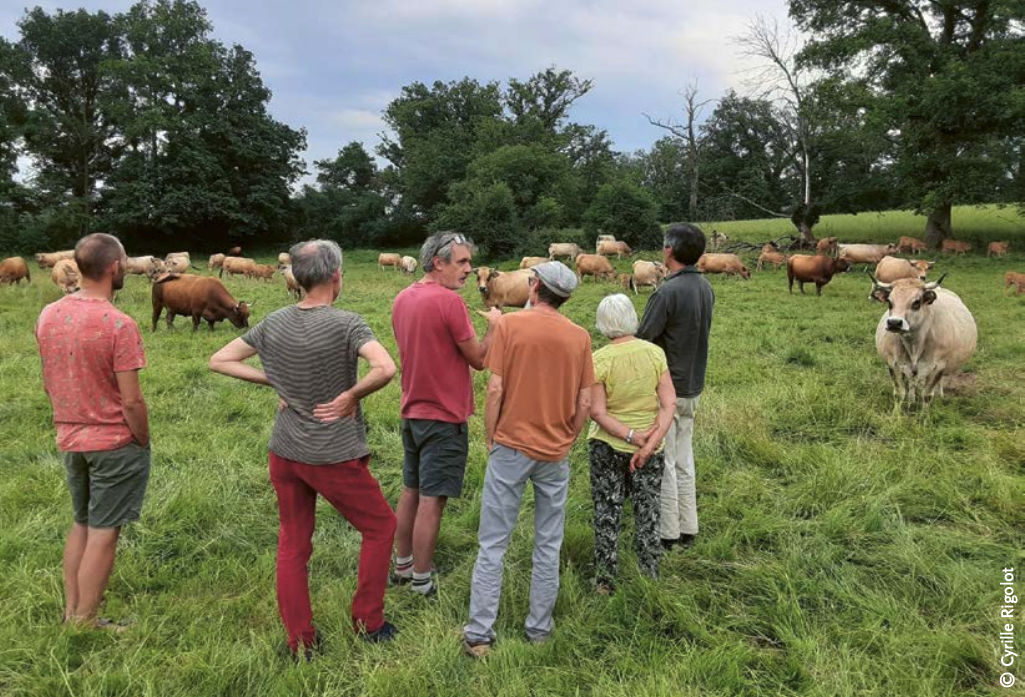
Figure 1: Collaboration between biodynamic farmers, advisors and academic researchers on a cow pasture in France.

Rigolot sees great opportunities for transdisciplinary research, i.e. the combination of biodynamic principles with other approaches. As an example, he cites the REPERE project, which was able to show that the application of biodynamic practices improves resistance to pests and diseases. In addition to their scientific significance, these results also led to positive effects in viticulture, such as a significant reduction in herbicides.

Comment:

Despite its sometimes controversial position within the scientific community - or precisely because of it - biodynamic agriculture holds enormous potential for sustainable innovation. Rigolot sees biodynamics as an ideal field for transdisciplinary research that offers new perspectives on human-nature relationships and promotes sustainable agriculture. It challenges traditional science and supports collaboration between scientists and farmers. This will not only lead to new agricultural practices, but may also provide answers to global challenges such as climate change and food security.


Sources and further links to this article