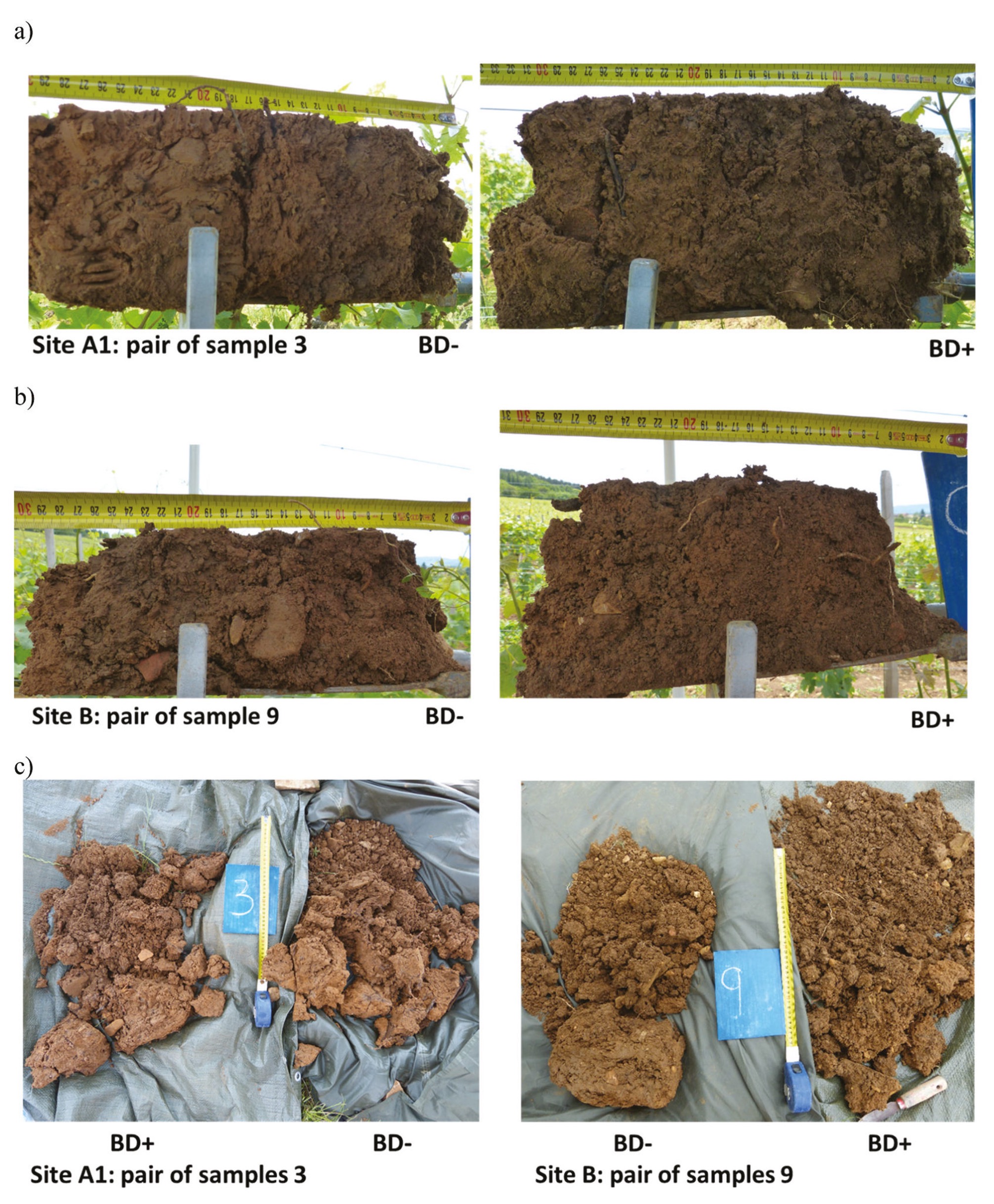
A field study was set up to investigate the effects of biodynamic preparations based on horn manure and horn silica (BD) on soil structure in five vineyards located on different soil types in Burgundy. The underlying hypothesis was that biodynamic preparations increase aggregate stability and improve soil structure. The results showed that the stability of soil aggregates during wet sieving was not different in the treatment with biodynamic preparations (BD+), compared to the one without (BD-). According to the visual assessment (VESS), improvements in soil structure in the BD+ treatment, compared to the BD- treatment, were not significant for macropores/biopores, block fall test for the upper horizon or colour of the lower horizon, but significant improvements were observed for the fall test on the lower horizon (p = 0. 009), upper horizon colour (p < 0.000), root penetration (p = 0.017), surface structure (stable aggregates, little encrustation, p = 0.006), upper horizon structure (p = 0.030), subsoil structure (p < 0.000), and the change in colour from upper horizon to subsoil occurred at a greater depth (p = 0.049) Based on the previously reported results, which show significant changes in soil microbial activity in the BD+ treatment, and using the same soil samples, it is possible that the observed differences in soil structure between BD+ and BD- are related to differences in microbial activity.
Authors:
Fritz J, Lauer F, Wilkening A, Masson P, Peth S 2021. Biological Agriculture & Horticulture,
Titel:
Agregate Stability and Visual Evaluation of soil structure in biodynamic cultivation in Burgundy vineyard soils.
Link:
https://www.tandfonline.com/doi/full/10.1080/01448765.2021.1929480