
The interface between indigenous worldviews and biodynamics
In 2020, a group of indigenous leaders published the online article “Whitewashed Hope”, encouraging the current organic agriculture movement to rethink its approach. The authors argue that permaculture and regenerative agriculture, among others, draw on indigenous practices without considering their context and underlying world views. In her report “A revitalisation of European farming and the promise of the biodynamic worldview”, Julia Wright from Coventry University examines whether and to what extent the concerns raised in “Whitewashed Hope” apply to biodynamic agriculture. She compares the statements of the online article with the work of Rudolf Steiner, with the aim of contributing to the discussion on how our world view influences current agricultural systems.
The interface between indigenous worldviews and biodynamics
Conventional agriculture promises high yields and profits but at the same time imposes enormous financial and environmental costs. Over the past century, several sustainable agricultural approaches have emerged in response to industrialised, conventional agriculture. These new approaches often make use of traditional practices. However, if such practices are merely copied without understanding the context and indigenous knowledge in which they are embedded, they will offer only limited solutions to the current ecological crises, according to the authors of “Whitewashed Hope”. The indigenous authors identify six areas where the Western world view differs from a traditional, naturalistic view:
- Where is nature? Is it seen as something separate from humans, or are humans part of nature?
- “Death” does not mean “dead”. Are inorganic materials like stones dead matter, or is the whole earth a complex, living being?
- From judgement to relationship. Do we classify nature into good and bad, beneficial and harmful, or are these terms invalid when we see ourselves as part of nature?
- Our words shape us. Do we use the English language to standardise and evaluate, or does each language have its justification in the place of its origin, and does each form of life have the same value?
- Holism includes history. Do the people own the land, or do the people belong to the land?
- Linear or circular? Is the earth dying, and humans must save it, or is everything in a cycle of constant change through death and rebirth?
Julia Wright relates these aspects to the extensive work of Rudolf Steiner, including the “Agricultural Course”, which forms the basis of biodynamic agriculture. She found synergies between the biodynamic and the indigenous approaches for all six main concerns raised in “Whitewashed Hope”. However, she also emphasises that not all biodynamic practices automatically mirror the underlying biodynamic concepts and not all biodynamic farmers agree with Rudolf Steiner's philosophy.
A significant similarity between the indigenous view and biodynamics is found in a holistic worldview, which helps to maintain a global balance. This also includes expanding our perspective beyond the material. Especially in Europe, which has been impacted by several waves of colonisation, it is essential to learn from the original indigenous cultures and world views. For Rudolf Steiner and the indigenous leaders, there is access to the inner nature of the world that cannot be understood in purely materialistic terms. Accordingly, a more holistic view of agriculture would also entail expanding agricultural research. This includes the way research is conducted and the researched objects themselves.
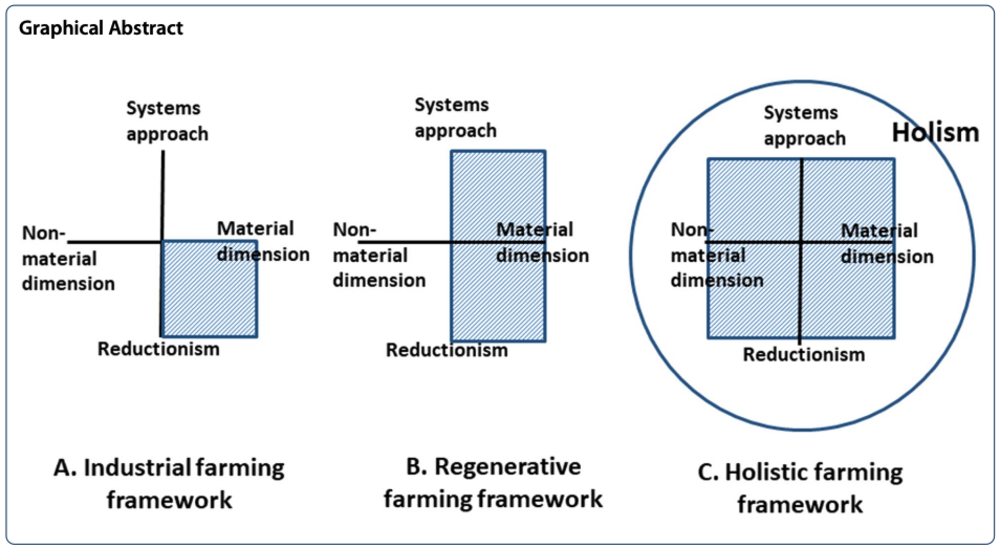
Figure 1: Graphical representation of different agricultural practices. A: The Industrial farming framework confines itself to the reductionist side of the material dimension. B: the Regenerative farming framework expands the concept to include a systems approach but remains on the material level. C: Holistic farming framework. Considering the non-material, spiritual dimension completes the holistic perspective of agriculture.
Commentary
In some ways, the indigenous leaders' approach to sustainable agriculture aligns with Rudolf Steiner's biodynamic principles. Both emphasise the importance of working with nature rather than against it, and both recognise the interconnectedness of all living beings. However, while indigenous leaders draw on traditional knowledge and practices, Rudolf Steiner's biodynamic methods are based on his spiritual insights. They are not necessarily bound to any particular cultural tradition. Even though the two approaches are not identical, they do not seem to stand in each other's way and in fact pursue the same goal: a more harmonious relationship between humans and nature.
Details of the original publication
- Author: Julia Wright
- Title: A revitalisation of European farming and the promise of the biodynamic worldview
- Journal: Chemical and Biological Technologies in Agriculture 9, 64 (2022)
- Link: https://doi.org/10.1186/s40538-022-00317-z
Link to the online article “Whitewashed Hope”